Posted on

Reflections on getting a new phone.

I have recently got a new phone – and it led me to think about a few things.

Let’s be straight from the outset; I wasn’t looking to upgrade, but the financial elements of my contract were such that I wanted to re-negotiate. The new handset was the sweetener in the deal.

I had resisted upgrading for some time because I was happy with what I had. The device did what I needed it to do, and I had become increasingly aware that more and more of my life was tied up in the phone that I owned.

In short, my perception was that the pain of change was greater than the pain of standing still and experiencing a catastrophic breakdown later on. So, I chose to look the other way.

Isn’t that what we do all too often?

I remember working with a business which was operating with old machines. At the time, the maintenance department did an excellent job keeping them going, and all was well. However, the original machine manufacturer had long since gone bust, so the spares on the shelf were not going to last forever. Also, the business running the machines had neglected to buy the drawings when they had the chance. Hence the opportunity to manufacture spares had also been lost.

This organisation was faced with a ticking time bomb – but the pain of doing anything about it caused them to look the other way – much like me and my phone.

It is true that until the discomfort of the present moment becomes greater than the perceived fear of the change, and hence the unknown, that most of us will put up with what we have today, even with the threat of something catastrophic occurring.

To plan for painful circumstances is not something that most of us feel comfortable doing – but when we hedge against the downside, the balance tips in favour of the transaction’s upside. We start to think more in terms of positive benefits, and action is then seriously considered.

Part of my perceived pain around swapping to a new phone was the estimated work of moving every piece of data across and starting again but, as it turned out, I needn’t have worried.

The handset I selected was a new, all improved, latest version from the same manufacturer and operating system that I was used to.

In this sense, the swap could be viewed as more of a gentle augmentation and gradual introduction of new technology. We often see a “fix the world” introduction of something that doesn’t fit with our current systems, which only causes more difficulty in the long run. Be honest – how much of your data is held “outside” of official systems, hidden away on individuals computers?

My decision to purchase something compatible undoubtedly paid off. Just moments after unpacking my shiny new device, it had connected itself wirelessly to my old phone and was transferring all of my data across! I didn’t have to refer to a hand-written list of telephone numbers once!

To me, this feature was way up in the stratosphere of the Kanu diagram and had undoubtedly influenced my purchase decision. Jeffrey Liker describes the eighth Toyota management principle as “adopt and adapt technology that supports your people and processes” – which strongly resonated at the time.

In wireless data transfer and set-up, the technology available certainly supported me in my need to change equipment. In terms of downtime, I was without a phone for approximately ten minutes. Technology had struck a huge victory for set-up reduction.

But has getting this new phone changed my life? Did I become instantly more productive?

The answer is no.

So why not?

Because I haven’t changed.

Think about where you work. Is there anything particular enabling technology from which you don’t get the full benefit?

Such a deficit is undoubtedly the case with me and my phone. I use it to make calls, text, take photos, and use social media – but I know it can potentially do so much more for me.

So, we circle back to the central theme of everything that I like to talk about, both in my books and on this site. Develop and place your faith in people. If you are a leader, your job description is clear; set the direction and coach people towards it – everything else on your scorecard comes for free.

If am I to get the full benefit of the astounding technology at my fingertips, I need to trust and take responsibility for my own learning. I must immerse myself in what is new. Only in this way can I release the technology’s potentiality and turn it into a tangible reality.

Then again, the actual truth is somewhat starker. People are the technology. Human beings are remarkable, yet we still do not understand our brains’ full functionality, any more than I comprehend the functionality of this shiny new phone.

Perhaps the question becomes this. Do we have the humility to learn?

We are each of us living in the experience of our own thought in the moment. Further, we are all doing the very best that we can with the information that is currently available to us. Through mind and consciousness, we project that outwards into the physical environments where we live and work – and get tricked that the transaction is happening the other way around.

To change how we experience our environment, we only have to accept that thought is pulling all the strings.

So, at the age of 46, I may consider that I am too old to learn all this new stuff – and that may be my resistance point when you ask me why I cannot use all the features on my new phone. But perhaps you might coach me, and ask: “where do you think that your resistance to learning is coming from?”

I might point to a host of poor learning experiences in the past – which I have built up into a portfolio of evidence that I cannot be developed any further. It is my wall which I hide behind, the wall that prevents me from changing and allowing the processes to improve around me.

“And where are those experiences now?” you ask.

“In the past.”

“So can they hurt you anymore? Is it possible for your resistance to travel through time, from the past?”

“Well, er, no?”

“So is it possible that you are experiencing your thought in the moment?”

Who knows where such a transformative coaching discussion could lead? But imagine if breaking through resistance to change was that easy?

The truth though, is that it is.

I speak more about the impacts of 3P Lean (the three principles of Thought, Mind and Consciousness) in part two of my book “Super Lean – Unlock Your Company’s Million-Dollar Edge.”

I would love you to read it and help push the discussion forward. Thanks for your time.

Posted on

Classic Book Review – “The Toyota Way – 1st and 2nd Editions” – by Jeffrey K. Liker.

This review piece is something of a first for me, here at simondgary.com.

Instead of reviewing one book, we’re going to be looking at two. The books are the hugely important “The Toyota Way” first and second editions, by the highly influential Jeffrey K. Liker.

I first read edition one of “The Toyota Way” over a decade ago, when I was fresh to my journey as a lean learner. If I am honest with myself, I probably didn’t understand a lot of it. Still, I took enough to know that it was a very significant book – after all, I had seen it being distributed as a course text for a high-level workplace course of which I was aware.

Fast-forward to the end of 2020, and I become excited to learn that a second edition is about to be released. What will be added, what will be changed? To help me understand, I immediately re-read the first edition and waited eagerly for news of the second.

A decade on, I was immediately able to understand just how magnificent the “Toyota Way” was. Further, I was able to see that many, perhaps including myself at times, had incompletely understood the message – picking up on the tools and missing the cultural side of transformation. I wondered how Mr Liker would address this in the second edition.

As a UK learner, I had to wait a little while to get my copy. I do not think it is an over-exaggeration to state that this was the most eagerly awaiting lean published event in nearly twenty years. You could not get a copy of “The Toyota Way: Second Edition” for love nor money.

When it eventually arrived, it was like Christmas morning all over again. I tore at the packaging to reveal a beautiful, bright red cover, bearing the legend “The bestselling classic – completely updated.”

And it was. Wonderfully so.

The original and the all new version.

Both books are tightly structured around the fourteen TPS Management Principles, but the new copy dives straight in. It is bigger and heavier than its predecessor, but that is because Mr Liker has packed in a great deal more fantastic material.

The Second Edition feels more people-centric to me, which is a trend that I am seeing in a lot of lean books now. The tools have become secondary. People are the beating heart of all business systems. Mr Liker explores the people element of lean very thoroughly, clearly delineating mechanistic and organic business systems.

The language is clear and concise, but the book’s beauty comes in the myriad examples, not all of them from Toyota. All of the anecdotes and stories are told in a superbly engaging way, leaving ample room for reflection on the reader’s part. Though each comes with the caveat: do not copy and paste – think how you could adapt this principle for yourself.

And it is in this caveat that the biggest, and most crucial difference between the two editions exists. “The Toyota Way: Second Edition,” has a much bigger focus on scientific thinking as part of our PDCA learning cycles. Here is where Mr Liker truly pinpoints the people element of the lean business system. Develop people, and everything else will naturally follow.

In “The Toyota Way: Second Edition,” Mr Liker offers the key to a sustainable, continually-improving crucible of a workplace, in whatever industry or sector that may be. Mr Liker’s book truly is for everyone.

I think it may be obvious that I think “The Toyota Way” is a remarkable book, fully deserving of its label as a classic. Further, I will state that I believe the Second Edition is an even better iteration, and the spirit of PDCA and kata is evident.

Lean authors, myself included, owe so much to heroes like Mr Jeffrey Liker. Every book that follows will owe a great debt to this most esteemed of writers. Mr Liker has given me much to think about and has offered me much to learn and be grateful for.

What the future holds? We cannot be sure, but it is comforting to think that great companies, like Toyota, and great minds, such as Mr Liker, will have a part to play.

Please, please do read this book. Five stars.

Please use this link to order your copy of “The Toyota Way – Second Edition,” by Jeffrey K. Liker.

Simon D. Gary is the author of the groundbreaking book “Super Lean: Unlock Your Company’s Million-Dollar Edge,” which is available for purchase by clicking this link.

Posted on

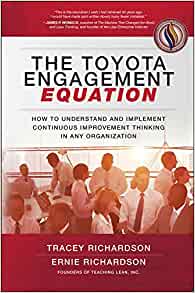
Book Review – The Toyota Engagement Equation – by Tracey & Ernie Richardson.

There is a tradition in the lean world that compels people to pay knowledge forward. This wonderful habit recognises that we have all been coached and moulded by others along the way, so to pass on our wisdom, is only right. It also recognises that we are just temporary custodians of our knowledge. To gift this know-how to others ensures that our lean traditions can be sustained and improved. There is something of the ancient oral tradition in all story-tellers of lean.

This selfless gifting of knowledge is the primary feeling that I got from “The Toyota Engagement Equation” by Tracey and Ernie Richardson.

“The Toyota Engagement Equation.”

One only has to search #sketchedwisdom on LinkedIn to appreciate just how much the Richardsons’ contribute to the lean community – and they do this for one reason only – because they care deeply about the topic in which they are both experts.

If you are coming to this book to learn about lean tools, you may find other books to better suit your purpose, for this is not a textbook.

What Tracey and Ernie have tackled here is the deep, organic understanding and culture that made Toyota so successful. The communication of the incommunicable would seem to be a daunting task, but here, it has been achieved with disarming charm and ease.

The book is tightly structured. There is nothing superfluous or redundant. As a book it is highly waste-free since it flows with stories, rather than explanatory text. I found myself making many notes of things I could take away and, I humbly say that I learned a great deal, for which I have much gratitude.

As I am humble in learning, Tracey and Ernie have humility in teaching – recognising that they are still on their personal learning journey. This quality makes the book a joy to read, like having your own coach in TPS. Learning and the gift of reflection are offered in abundance.

Whenever I feel that I am approaching a level of relative expertise in lean topics, it is rewarding to read a book like “The Toyota Engagement Equation.” The words will undoubtedly echo deep into and inspire my 2021 – I hope you can come along with me on this blog.

I can genuinely recommend that you read this book. I thoroughly enjoyed it a will, no doubt, read it many times again.

Thank you, Tracey and Ernie.

As this is going to be my last post of 2020 (and what a year it has been), I would like to take this opportunity to wish all my visitors a very Merry Christmas and a Prosperous New-Year.

Much gratitude to you all.

Simon D. Gary is the author of Super Lean – Unlock Your Company’s Million Dollar Edge.

This new book opens the discussion on the very future of lean business, team development and respect for people. Further details are available here.

Posted on

Book Review – “2 Second Lean” by Paul A. Akers.

If I were to sum up “2 Second Lean” by Paul Akers in one word, that word would be “passion.”

So, Paul Akers is passionate about lean?

Yes…only it’s more than that.

Paul Akers being passionate about lean is not the input; it is the output. The author’s passion for lean stems from his burning desire to give value to all of those around him, his fellow business owners, his customers and his employees.

He is passionate about lean because it is the best way to show his love and respect for people.

Some lean books, let’s admit it, can be a bit of a grind. Akers writes with the brightness that imbues his every waking moment. The text is light, humble and packed with impactful gems of wisdom. There are no complex graphics, tables, nor calculations, nor are there are detailed tool descriptions, theories, and action plans. There is, however, oodles of joyous enthusiasm which, as it turns out, is more than enough.

Akers message is the simple realisation that all people are valuable and, as such, does it make sense for them to work in, or pay for waste?

“2 Second Lean” by Paul A. Akers.

The book is also packed with QR codes for just a small, but telling sample of the videos on the FastCap public YouTube channel – which are freely shared with generosity and warmth. The book also contains great reflection questions at the end of each chapter, giving the work a real vitality.

“2 Second Lean” is not a textbook that looks to stretch your knowledge, no. This book is a continuous call to action, almost unlike any lean book that I have ever read. You can practically hear Paul in your ear saying:

“Why are you still reading this? Why aren’t you up and doing something? Start with you and start by fixing something that gets on your nerves! And don’t let perfect get in the way of better!”

I am only sorry that it has taken me over a decade of working in lean to finally read this book. Whether you are a seasoned professional, or a welcome friend taking their first steps, I would urge you to read “2 Second Lean” at your earliest convenience.

An easy 5 Stars.

Simon was reading the new, Shingo Award-winning third edition, with five additional chapters.

Follow this easy link to obtain your copy of “2 Second Lean.”

Simon D. Gary is the author of the new book “Super Lean: Unlock Your Company’s Million-Dollar Edge.” The book opens up the lean discussion into how to truly uncover the latent potential of the wonderful people in your team. It is available on Amazon and through this link.

Posted on

Clarence Saunders: A Forgotten Lean Hero?

History is littered with individuals who made stunning contributions to humanity, but who were not credited with their foresight at the time.

Take, for example, Dr Spencer Silver. While attempting to create a strong-adhesive, he accidentally made a low-tack, reusable sticky substance, for which there was seemingly no application. Then, a few years later, as one story goes, a gentleman by the name of Art Fry used it to anchor the bookmark in his hymn-book. From here, the sticky note was born, and a generation of lean thinkers was enabled to make awesome flow-maps!

The subject of today’s post is a name that I first came across many years ago, and I have been stunned by his simple vision ever since.

Clarence Saunders was the inventor of the supermarket. On the 11th of September, 1916, at 79, Jefferson Avenue, Memphis, Tennessee, Saunders opened a store called Piggly Wiggly.

The concept was stunningly simple, and yet utterly remarkable, as the best ideas always are. Before the opening of this shop, it was traditional that customers would enter a store and give their list to a clerk. The clerk would the busy themselves by going to the appropriate storage locations and picking the items that the customer desired.

There were obvious problems with this. Firstly, there was the customer waiting time. If you were third or fourth in the queue, you knew you were in for a wait. You could see the staff dashing about, which gave some impression of value-add, but you knew that they were not working on your request.

Secondly, a customer could have no real idea if the things on their list were in the store. Ironically, this issue arises with online grocery shopping. We can make a request, but if our preferred item is not in stock, we do not have the luxury of picking our own substitute, or of deciding to leave the shop without it.

Thirdly, the clerk is experiencing motion waste. The items on the list will not necessarily be in the order in which the clerk would like to pick them, so some serious thought is also required to minimise trips back to the same storage locations.

In Saunders’ new store customers served themselves. They entered via a turnstile and followed a pre-designated route to the check-out, a model still used by a Swedish furniture giant today. In this way, customers passed all the products available and selected those that they liked for their basket.

Commodities, such as flour and sugar, were packaged into smaller quantities out in the back and marketed directly to the customer in eye-catching packets. It was the beginning of branding and product identity. Fruit and vegetables were available to be picked from bins, and there were even chiller cabinets, containing goods like milk and butter.

To the customer, it must have been a startling experience, but they loved it, and the Piggly Wiggly brand started to spread.

Saunders, by the very nature of his concept, would have been using lean principles in his stores. Piggly Wiggly represented both a pull and a push system. Stock in the store would only be replenished when consumed by a customer, which sent clear signals into the supply chain to trigger storeroom replenishment. But the use of a push system was also ingenious. By forcing customers to pass all of the shelves on their route around the shop, Saunders unlocked the profit-centre of impulse buying.

With costs, such as staff and excess inventory stripped out of his business model, Saunders was able to pass savings onto his customers in the shape of lower prices. He had realised the lean ideal of creating more value for the customer at a lower cost. This goal was achieved through an innate ability to reduce waste and understand the voice of the customer.

That Saunders eventually became bankrupt and lost control of his empire may be the sad end to this story. But I like to reflect that around forty years later, men like Taiichi Ohno were observing the US supermarket and taking concepts like JIT, pull, and FIFO, back to their native Japan.

These ideas would eventually become enablers such as Just-In-Time and Kanban, both important mainstays of the revered Toyota Production System.

I would like to think that, as we continue to celebrate TPS, we should also tip our hat in the direction of Mister Clarence Saunders, a true innovator and visionary.

Simon D. Gary is the author of the new book “Super Lean: Unlock Your Company’s Million Dollar Edge,” which offers breakthrough discussion into the topic of lean. You can buy your copy here.

Posted on

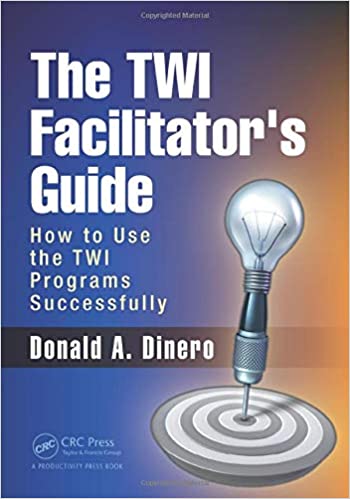
Book Review – “The TWI Facilitators Guide – How to Use the TWI Programs Successfully” – by Donald A. Dinero.

Life has a wonderful quality that brings you down with a gentle bump when you think you know about something.

Every so often, along comes a timely reminder that thankfully restores one’s sense of humility and draws you back into the “shu” stage of “shu-ha-ri,” and that blissful state of learning.

I used to think that I was relatively well versed in TWI (Training Within Industry.) It was a delight to find out that I was not.

A work colleague clued me in on “The TWI Facilitators Guide” by Donald A. Dinero, and I immediately sought to buy a copy. I am so delighted that I did.

TWI, or Training Within Industry, has its origins in the war economy of 1940’s USA. Companies needed to find solutions to boost productivity, and required to do so with an influx of new and inexperienced staff.

As Dinero explains, four men stepped forward to help from US industry. Their names were C.R. Dooley, Walter Dietz, M.J. Kane and William Conover. They may not be as celebrated as Sakichi Toyoda, Taiichi Ohno, Daniel Jones, or Mike Rother, but their legacy lives on, and this book is a celebration of that.

It is clear that Dinero believes deeply in, and is passionate about the TWI “J” programs. It is this passion and belief that permeates every word in this work. I do not doubt that this project was a labour of love.

The outcome is probably one of the most definitive tomes on the subject of Training Within Industry. Dinero’s attention to detail is simply stunning, as is his faith in the original training content. No point, however small, is left unchecked or unexplored, and it is clear that the book is one giant set of cascading Job Breakdown Sheets.

To apply TWI to write about TWI is simply masterful.

The book covers all three of the TWI programs, namely Job Instruction, Job Methods and Job Relations. Admittedly, the bulk of the material is on the Job Instruction Four-Step Program, but this is to be expected.

That is not to say that Job Methods or Job Relations are treated lightly. They are not. Even after a decade in Continuous Improvement (I am still learning), I found much that was refreshing in Dinero’s explanations on Job Methods and ECRS Logic.

What I also saw was Dinero’s rigid belief in the primary tenets of lean. Have respect for people and take responsibility for creating a supportive, learning environment. He touches on the psychology of lean, concerning the way that people interact with this body of knowledge. I am convinced that this is where the future of lean lies, and I suspect Dinero believes this too.

Excitingly, Dinero does not narrow the scope of the book to talk merely of the programs.

The author also supplies a roadmap to lead you from the original concept, through to selling the idea, onwards to initial delivery and forwards into a sustainable training system. This level of information is a fantastic addition. It makes the TWI topic something that is actionable, and this, after all, is the only reason that you should read this book – with the intention of application.

This book is a very welcome addition to my lean library, and one I would urge all interested lean practitioners to read. It is rewarding in so many ways, and the supplementary materials provided are fantastic.

An easy five stars.

Simon D. Gary is the author of the new book “Super Lean – Unlocking Your Company’s Million Dollar Edge.” Stay tuned to this blog for further details.

Posted on

Product Review – Allplants Vegan Meals.

As a Continuous Improvement professional, I am used to looking at a process and attempting to squeeze out an extra few per cent of performance.

But, as with all things lean, we must, at some point, put people back in the centre of our thinking. When we do this, it soon becomes clear that we must start where we stand and begin from the inside out.

Take Paul Akers for example, he of Two-Second Lean. The man is simply full of energy and vitality. Is this just a character trait? Possibly. But maybe he is running on higher octane fuel – his engine is driven from the foundation of his diet.

So, I looked within. Could I honestly state that my diet enhanced my performance in the workplace? If anything, the way I was eating was having a detrimental effect. If I wanted to find that extra few per cent, I had to look at how I was feeding my energy.

With this minor epiphany, I looked up a company called Allplants. As I remember, an advert appeared on my Facebook timeline. For some reason, Mr Zuckerburg seems to know what products I need before I know – so I followed the link.

Arriving at the website, it seemed clean, bright and intuitive – so I had a further look around. The scheme works a little like this. You chose six meals and a subscription plan. The plan enables you to have a box of meals delivered at a time-frequency of your choice. You can have a box every week, every couple of weeks, or even once a month. The option is yours.

As this was an experiment, I chose monthly, but then found it easy to cancel the recurring subscription plan – so you have need have no fear of being locked into something you might not want.

Next comes the difficult bit.

From a list of over thirty meals, you have to choose just six. I navigated this challenge eventually and waited a couple of days for delivery. (It should be noted that I ordered on a Bank Holiday Weekend, so delivery really is rapid.)

What struck me first is how beautifully packaged the meals were. They arrive frozen, in a remarkable thermal box. You are provided with a return label for the packaging, and this can be dropped off at a convenient location near you. Mine was left outside in a safe place for a few hours and were still beautifully frozen when I unpacked them.

The meals themselves are also strikingly packaged and come in natty cardboard sleeves, so there is no doubt as to what meal you have. One pleasing aspect of the sleeve is the autograph of your chef on the side. I felt this small touch connected the customer with the business. It was clear that somebody had taken pride in the preparation, and cared about the customer experience.

One thing to mention here. Do you know how ready meals often have tiny portions? Well, I attempted to alleviate this by ordering the two-person size. I needn’t have worried. The two-person size is very much as described! If there is just one of you, a single portion will be sufficient!

Also, know that all meals cook from frozen. This feature is great for me because I often forget to take food out of the freezer before I go to work. It was nice to know that I was always going to have a hot, nutritious meal to eat when I got in after a hard day in the automotive world.

Now onto the important bit – the meals I chose:

  • Smoky Soul Chilli – This was delicious! The chipotle chills were a bit hotter than I was expecting, but this was a welcome surprise. A striking addition was the crunchy coconut cornbreads. I felt they were remarkably innovative and underlined a theme for all of the dishes. As flavoursome as all the food was, the chefs also worked hard to add different textures. That bit of crunch elevated the dish.
  • Shepherd’s Pie – Now, between you and me, I am something of a Shepherd’s Pie connoisseur, but this was wonderful! That sweet potato topping complimented the rest of the dish and the addition of the paprika crumb, for texture was glorious.
  • Lasagne Noci – The winner here was the butternut squash bechamel. Accompanied by walnut ragu and mined mushroom, it was as good as any lasagne that I have tasted.
  • Super Green Risotto – Again, this was a very textured dish, with complimentary and fresh flavours. The seasonal greens tasted as if they were picked yesterday, and you could just feel that they were doing you good. I would say this was a summery dish, but I could equally see myself eating this on a dark winter’s night.
  • Nacho Bean Chilli – My second chilli dish on the list and equally as good as the first. With so many ingredients, I guess it would be easy to produce something where flavours were battling. However, some serious R&D has clearly been done by the good people of Allplants, as this meal was awesome! Add in the tortilla chips for texture, and we have another winner.
  • Teriyaki Udon – Not my favourite of the dishes, but this is because I am not at all adept at eating noodles! I was still able to recognise a beautifully textured and balanced piece of cooking, put together with craft and love.

To conclude, I think this was an experiment that I will definitely be repeating. With all those other options to try, it would be churlish not to! I am recognising that diet, hydration, exercise, and quality sleep are vital ingredients to finding that little bit extra. Therefore, these meals can be certainly described as adding value to my life, while saving time and helping me cut out junk food.

I’m off back to https://allplants.com/ to have a look at what my next order will consist of. Perhaps you will join me there?

Simon D. Gary is the author of “Kaizen Your Life” – the book that describes how you can apply the techniques of the Japanese Business Masters in your day to day living.

Posted on

Classic Book Review – “Man’s Search For Meaning” – Viktor E. Frankl.

“The meaning of life differs from man to man, from day to day and from hour to hour. What matters, therefore, is not the meaning of life in general but rather the specific meaning of a person’s life at a given moment. To put the question in general terms would be comparable to the question posed to a chess champion: “Tell me, Master, what is the best move in the world?” There simply is no such thing as the best or even a good move apart from a particular situation in a game and the particular personality of one’s opponent. The same holds for human existence. One should not search for an abstract meaning of life. Everyone has his own specific vocation or mission in life to carry out a concrete assignment which demands fulfilment. Therein he cannot be replaced, nor can his life be repeated. Thus, everyone’s task is as unique as is his specific opportunity to implement it.”

I must admit, I am nervous about writing this book review. Will I be able to find the words to make it meaningful and do Viktor E. Frankl’s classic text just a fraction of justice?

So I begin with the extensive quote above, in which Frankl describes the shapeshifting nature behind the meaning of life. It is in the moment, of the moment, for the moment. Tomorrow, that same soaring ideal may not offer you a similar feeling of sustenance.

“Man’s Search for Meaning” is a slight, but towering tome. It’s author, Viktor E. Frankl, is considered to be the father of Logotherapy, often called the Third Viennese School of Psychotherapy, since it builds on the work of Freud and Adler.

In the second half of the book, Frankl unpacks the basic tenets of Logotherapy. His paradigm has its root in the Greek word Logos, or “reason” – following the existential reckoning that a life imbued with real meaning is a life that can withstand any hardship, however extreme.

We saw recently, in our article on Ikigai, that meaning has a transformative effect on our attitude. We may find that nothing in our external locus changes, but the realisation of a deep purpose can nourish our outlook and cleanse our thought. This change of attention is enough to become free – we are only ever one thought away from mental clarity and wellbeing.

Frankl shares some brief case studies in which he reframes the struggle of his patients in terms of a stoic meaning. Particularly striking is the story of the grieving husband. This man’s daily struggle was almost overwhelming until Frankl asked him to consider the following. In surviving his wife, had this man not spared her the agony of his passing? In this sense, Frankl’s patient was able to bear his grief, as he had found meaning in it. The same struggle was spared for the wife he so deeply loved.

I found this story to be especially poignant, given the horrors described in the first half of the book. For it is here that Frankl describes the three years he spent in various concentration camps, including the darkly infamous Auschwitz.

At the time of his internment, Frankl had already been formalising Logotherapy for around sixteen years. In the squalor and inhumanity of Auschwitz, Frankl’s theories would be exposed to the sternest of tests – sterner than anyone dare ever imagine.

Frankl describes with skill and a manner of detachment, the three phases of the camp prisoner. First came shock. Then, a strange apathy quickly followed. Frankl describes how the horror of seeing the daily beatings was soon replaced by an acceptance of their inevitability.

The final stage, as Frankl painfully writes, was disillusionment. The author notes that when this stage was reached, death swiftly followed. The certainty of imminent death replaced the former glimmer of hope. Frankl observed that, at this point, the doomed fellow would smoke the last of his hard earning cigarettes. In a life with hope, this item would be kept and exchanged for extra soup.

So, it was through the life purpose of sharing Logotherapy that Frankl found meaning and the thread that tied him to survival. Many of his family were not so lucky. His wife, Tilly passed in Belsen. His father died in Terezin, and his mother and brother were killed in Auschwitz. It is difficult to fathom the grief and guilt that Frankl must have carried after and, indeed, he does not dwell in this.

In the world in which we find ourselves, there is one other colossal lesson the Frankl gives. Under the seismic pressure of facing death on an hourly basis, Frankl describes two extremes. At the one end are the murderous capos, privileged prisoners whose cruelty almost matched that of their captors. One the other extreme, Frankl shows images of men and women who went to their deaths to save others, full of stoicism and peace. Perhaps in these tragic ends, these victims had found their own meaning – in offering the extension of life, and therefore hope, for another loved individual.

The lesson, however, as Frankl states, is one of choice. We always have a choice in how we react to our circumstances – even if they are the most horrific and fearful. It is a sobering thought to bring this article to a close.

“Man’s Search For Meaning” by Viktor E. Frankl is one of the most important books that has ever been written. It is moving, yet at the same time, soaringly liberating. It is a fitting tribute, lesson and moral compass. All should, one hopes, get the opportunity to read it. Beauty and affirmation are present in all things.

My closing hope echoes my opening fear. If I have not done this book a fraction of justice and tribute, then it is because my words have failed me. Please forgive me. Perhaps mere words could never be enough.

Love to you all, and I hope you find your meaning.

Posted on

Book Review – “Fearproof Your Life – How to Thrive in a World Addicted to Fear.” – by Joseph Bailey.

“Fearproof Your Life” by Joseph Bailey is a book that I highly recommend that you read.

For an author that has spent his professional life as a psychotherapist, this book represents the leading edge of human psychology.

The book draws on three simple principles, thought, mind and consciousness. As the monk Dandapani reminds us; we are consciousness flowing through mind. When we accept this principle and halt our consciousness on our true selves, this book can serve as both a map and an anchor.

“Fearproof Your Life” is exceptionally well written and flows with the ease that this book can unlock for all of us. It is incredibly accessible, as the reader realises that concepts revealed have been hiding in plain sight.

So, what can we expect if we are able to silence the fear with which our ego seeks to protect itself? Bailey explain, in his engaging way, that the gift is connection. It is both a connection to our higher, universal selves and, by extension and compassion, a deep connection with one another. Bailey uses the compelling metaphor: if fear is the ocean in an archipelago of our own islands, then, when it is drained – the illusion of the individual and the ego is shown to be false. It is for this reason that any hatred for others, for whatever reason, is a reflected hatred of ourselves.

Bailey goes on to reveal that the language of our connection with our True Self is intuition – a voice that many of us have long forgotten.

This revelation got me thinking about the nature of business, and how we are becoming increasingly reliant upon reams of data to help in our decision making. Surely there must still be room for intuition and hunches in our working world?

We tend to reserve this sort of thinking to the world of our creatives, but Bailey would argue that none of us are any more creative than another. Those that drive progress through inspiration are just perhaps more adept at listening to and trusting that inner voice. Bailey shows that this quality is within reach of us all.

The Three Principles still remains one of the worst hidden secrets in human development, and “Fearproof Your Life” may well become one of the core texts that finally brings this most empowering of topics to a broader audience.

For this reason it is very easy to recommend this work, and I can definitely say that Joseph Bailey will be an author whose work I will be exploring further.