
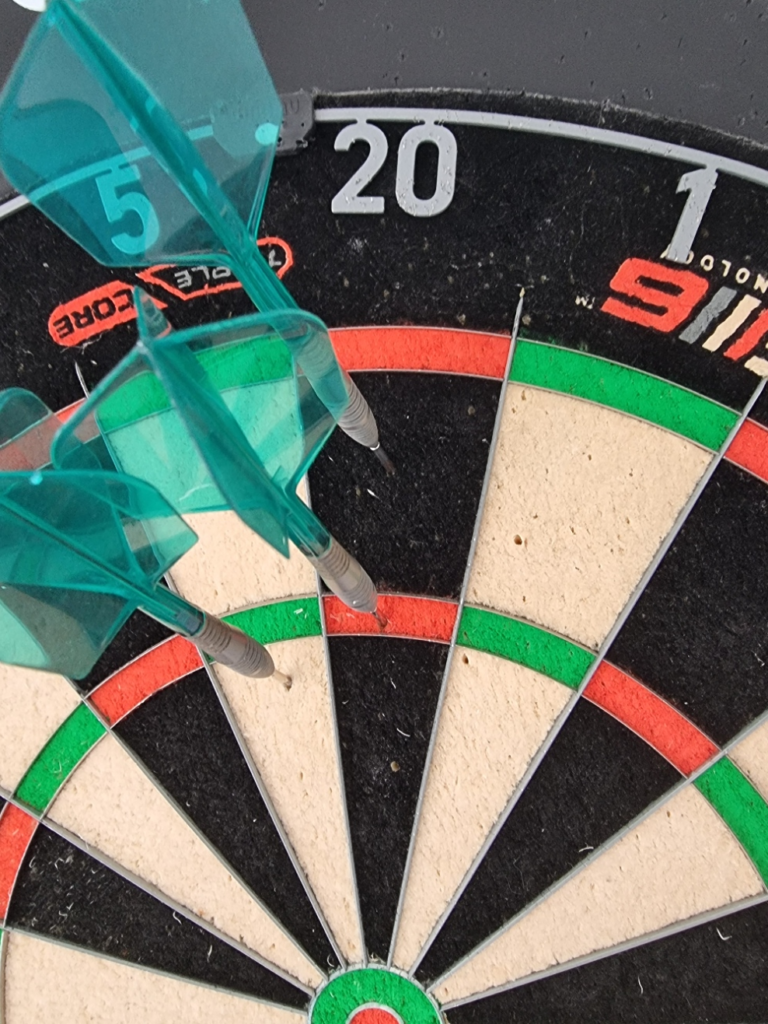
The photo above shows an eighty-five scored in darts. Most people would see a respectable throw. I see three completely different lessons.
The first dart was released slightly early and flew high into the twenty. The second was thrown lower, but was dragged slightly into the five. The last found the desired line and length and thumped into the treble-twenty.
The result? An acceptable score of eighty-five.
But let us dig a little deeper.
An outside observer would watch this throw and would assume that all three darts were thrown in exactly the same manner.
An unskilled player would not know exactly what had happened but would be happy with the outcome.
But what if, like me, you had been playing for forty years? Let me assure you that each of those darts felt different.
Now, I am by no means a skilled player but, at my best, there have been times when I have released a dart and have known it would hit the target before it reached the board. It is one of the best feelings in the game, when each of the segments on the board feels like it is on the end of your arm.
So how do we get to a point where “feel” gives us feedback?
Let’s go back to the score of eighty-five. The actual difference between the technique used is miniscule, but even a minor difference is amplified in the way to the board. Launch an aircraft just a few degrees off course and, unless corrected, the error will be magnified until it misses the destination by miles.
What separates average players from good ones is often their ability to learn from feedback. This throw gave me three feedback loops. Too high, left, just right. If I can differentiate how each of those efforts felt, I should be able to replicate the third dart more often and improve.
The trouble is, most casual players have already walked up to the board and retrieved their darts by now. They have not taken the time to reflect on their feedback loops. Some, with innate talent, will find the feel naturally, others will have to find it through many, many repetitions, and some, sadly, will never find it at all.
But this is exactly how we achieve craft skill within manufacturing processes. Repetition on its own is not quite good enough. Repetition with constant feedback loops is nearly there. The sweet spot is repetition with acknowledged feedback loops and reflection. Eighty-five points might be within the acceptable limits of what I would have liked to score, but remember, my target at the outset was one-hundred and eighty – the perfect score available.
The score told me what happened. The feel told me why it happened.
TWI JIT recognised this importance of feel and skill many years ago. “Listen for the satisfying click when you fit this part.” That was the instant feedback loop. When this information is ignored, defects will surely follow.
Repetition-feedback-reflection-repetition is a golden sequence, and we must be more attentive around the middle two steps.
We have a great saying that sums up repetition without feedback and reflection. We call it “going through the motions.”
For many years, I did just that when throwing darts, and I called it practice. I am beginning to realise that this is why I got to a certain level but could never get better. I couldn’t hear what my outcomes were telling me. Perhaps that is one of the more nuanced meanings of “gemba.” Not simply going to where the work happens but learning to listen to what the work is trying to tell us.